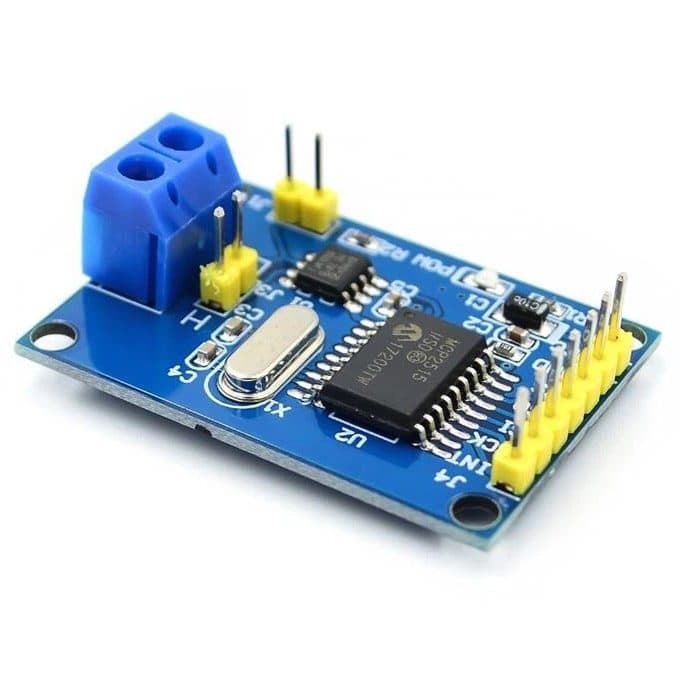
MCP2515 CAN Bus Module with TJA1050 Transceiver and SPI Interface
Prices updated: 12 Oct 2026
Compare prices
| Store | product | Price | View in store |
|---|---|---|---|
 Makers ElectronicsCheapest Makers ElectronicsCheapest | MCP2515 CAN Bus Module TJA1050 Receiver SPI For ARM Controller | 160 EGP | View in store |
 Future Electronics Future Electronics | MCP2515 CAN-BUS Controller and Transceiver Module | 180 EGP | View in store |
 Microohm Microohm | MCP2515 CAN Module TJA1050 Receiver SPI 51 Single Chip Program Routine Arduino | 210 EGP300 | View in store |
 UGE UGE | MCP2515 CAN Module TJA1050 Receiver SPI 51 Single Chip Program Routine Arduino Uno | 225 EGP | View in store |
Price history
Lowest daily price, last 90 days
Not enough price history yet.
Lowest price recorded: 160 EGP
About this product
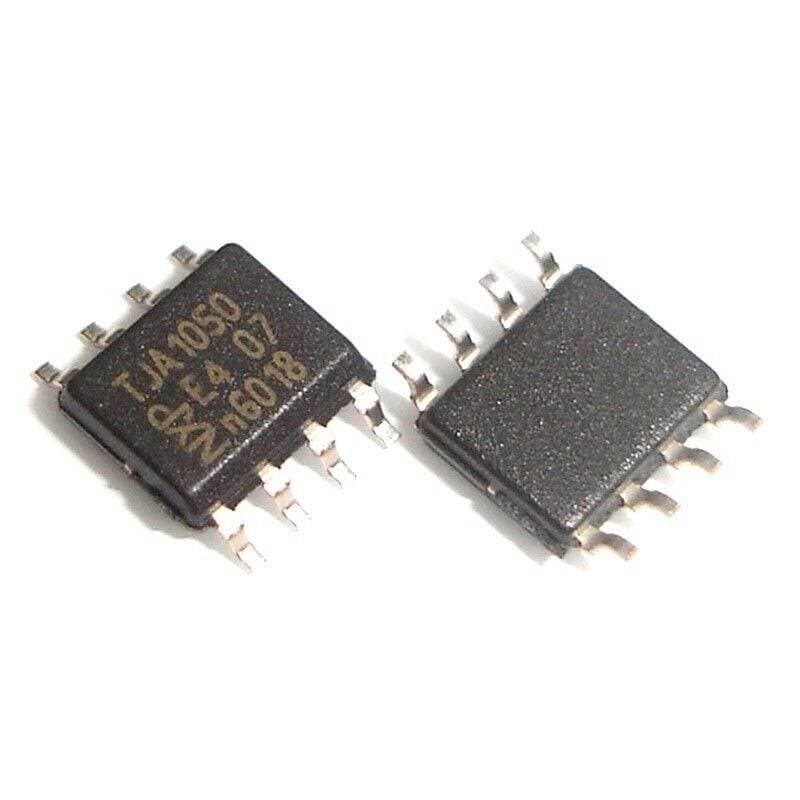
This MCP2515 CAN bus module combines the MCP2515 CAN controller with a TJA1050 high-speed CAN transceiver, and connects to a microcontroller over SPI. It supports CAN 2.0B at up to 1 Mb/s with 0 to 8 bytes per frame, and includes an 8 MHz crystal and a 120 Ω terminal resistor. It is commonly used to add CAN communication to Arduino, automotive and industrial control projects.
Specifications
- Protocol
- CAN 2.0B
- Maximum bit rate
- 1 Mb/s
- Host interface
- SPI
- Transceiver
- TJA1050
- Crystal
- 8 MHz
- Terminal resistor
- 120 Ω
- Supply voltage
- 5 V
- Typical current
- 5 mA
Frequently asked questions
What is the price of MCP2515 CAN Bus Module with TJA1050 Transceiver and SPI Interface in Egypt?
MCP2515 CAN Bus Module with TJA1050 Transceiver and SPI Interface currently costs between 160 and 225 EGP across 4 offers in Egypt.
Where can I buy MCP2515 CAN Bus Module with TJA1050 Transceiver and SPI Interface in Egypt?
MCP2515 CAN Bus Module with TJA1050 Transceiver and SPI Interface is available from Makers Electronics, Future Electronics, Microohm, and UGE. Compare the offers above to find the best price.
How do I wire the MCP2515 module to an Arduino Uno?
Connect VCC to 5 V and GND to GND, then connect the SPI pins to the Uno hardware SPI pins: SCK to D13, SI (MOSI) to D11, SO (MISO) to D12, and CS to a free digital pin such as D10. The INT pin goes to a digital pin such as D2. Check the labels on your module, as pin names can differ slightly.
Can it connect directly to a 3.3 V board such as ESP32?
The module is designed around a 5 V supply, so check the logic levels before connecting it to a 3.3 V board. Use a level shifter where needed. Also, on a CAN bus only the two ends need the 120 Ω termination, so remove the onboard resistor on middle nodes if the module allows it.