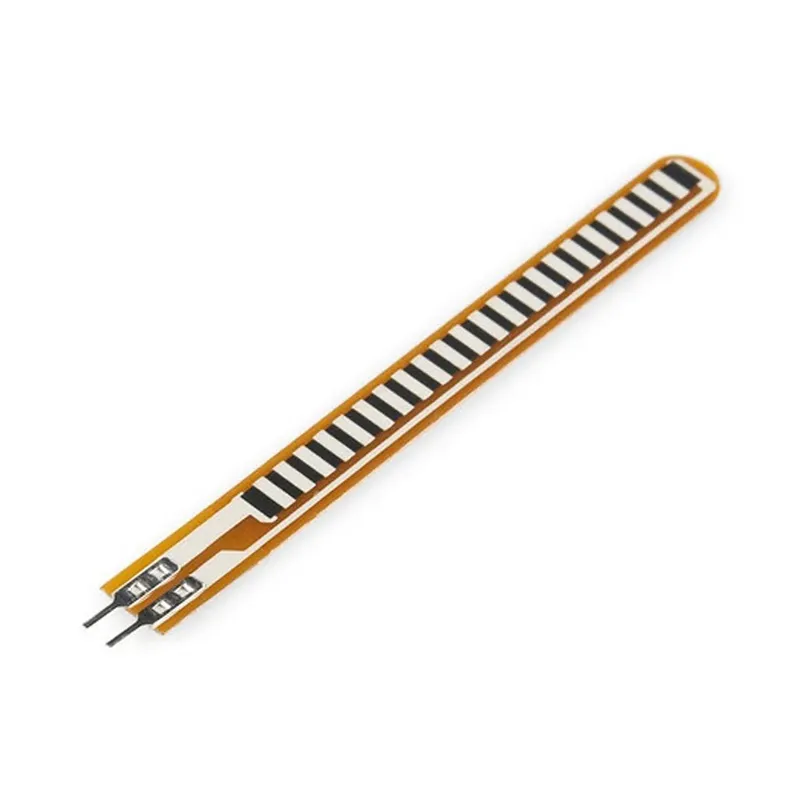
Flex Sensor 5.6 cm (2.2 inch) Bend Detection
Prices updated: 12 Oct 2026
Compare prices
| Store | product | Price | View in store |
|---|---|---|---|
 Future ElectronicsCheapest Future ElectronicsCheapest | Flex Sensor 5.6 cm (Detect Bending Motion) | 620 EGP | View in store |
 Microohm Microohm | SpectraSymbol Flex Sensor 2.2″ Bend Sensor for Hand Gesture Recognition 56mm Original | 850 EGP1,000 | View in store |
 Makers Electronics Makers Electronics | Thin Film Sensitive Resistance Flex Sensor 5.6cm | 850 EGP | View in store |
 RAM Electronics RAM Electronics | Short Flex/Bending Sensor 2.2" (56mm) | 950 EGP | View in store |
Price history
Lowest daily price, last 90 days
Not enough price history yet.
Lowest price recorded: 620 EGP
About this product
A 5.6 cm (2.2 inch) flex sensor whose resistance changes with the amount of bend: the more it bends, the higher its resistance, returning to its original value when straightened. Typical resistance ranges from about 10 to 50 kΩ at a 90° bend. Used in gaming gloves, joysticks, musical instruments and assistive devices.
Specifications
- Length
- 5.6 cm (2.2 in)
- Sensor type
- Resistive bend sensor
- Resistance range
- About 10 kΩ to 50 kΩ at 90° bend
- Output
- Resistance change (read via voltage divider)
Frequently asked questions
What is the price of Flex Sensor 5.6 cm (2.2 inch) Bend Detection in Egypt?
Flex Sensor 5.6 cm (2.2 inch) Bend Detection currently costs between 620 and 950 EGP across 4 offers in Egypt.
Where can I buy Flex Sensor 5.6 cm (2.2 inch) Bend Detection in Egypt?
Flex Sensor 5.6 cm (2.2 inch) Bend Detection is available from Future Electronics, Microohm, Makers Electronics, and RAM Electronics. Compare the offers above to find the best price.
How do I read the flex sensor with an Arduino?
Build a voltage divider with a fixed resistor (for example 10 kΩ), connect the midpoint to an analog pin, and read it with analogRead(). The reading rises or falls with the bend, depending on how the divider is wired.
Can it be powered from 3.3 V or 5 V?
The sensor is a passive resistive element, so the voltage depends on your voltage divider and your microcontroller's ADC reference. Choose a supply voltage that matches your board's analog input range.