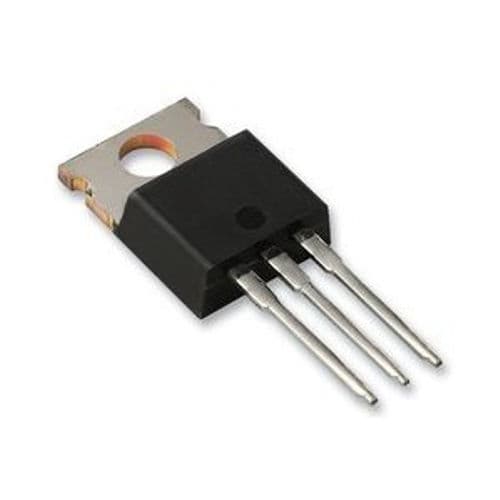
BD140 PNP Power Transistor 80V 1.5A TO-126
Prices updated: 12 Oct 2026
Compare prices
| Store | product | Price | View in store |
|---|---|---|---|
 Makers ElectronicsCheapest Makers ElectronicsCheapest | BD140 Bipolar Transistor PNP 80V 1.5A TO-126 | 3 EGP | View in store |
 Microohm Microohm | BD140 PNP Transistor | 4 EGP6.5 | View in store |
 UGE UGE | BD140 PNP medium 3A power transistor TO-126 | 10.26 EGP | View in store |
Price history
Lowest daily price, last 90 days
Not enough price history yet.
Lowest price recorded: 3 EGP
About this product
The BD140 is a PNP bipolar power transistor in a TO-126 plastic package, used as a switch or amplifier in medium-power circuits. It handles collector currents up to 1.5 A and collector-emitter voltages up to 80 V, which makes it suitable for driving relays, small motors and high-power LEDs. It is the complementary partner of the NPN BD139.
Specifications
- Polarity
- PNP
- Max collector current (Ic)
- 1.5 A
- Collector-emitter voltage (Vceo)
- 80 V
- Collector-base voltage (Vcbo)
- 80 V
- Package
- TO-126
- Collector dissipation (Ptot)
- 12.5 W
- Complementary type
- BD139 (NPN)
Frequently asked questions
What is the price of BD140 PNP Power Transistor 80V 1.5A TO-126 in Egypt?
BD140 PNP Power Transistor 80V 1.5A TO-126 currently costs between 3 and 10.26 EGP across 3 offers in Egypt.
Where can I buy BD140 PNP Power Transistor 80V 1.5A TO-126 in Egypt?
BD140 PNP Power Transistor 80V 1.5A TO-126 is available from Makers Electronics, Microohm, and UGE. Compare the offers above to find the best price.
How do I use the BD140 to switch a load from a microcontroller?
Use it as a high-side switch: connect the emitter to the positive supply and the load between the collector and ground. The base must be pulled below the emitter to turn it on, so a microcontroller pin usually needs an NPN driver stage between the pin and the BD140 base. Add a flyback diode across inductive loads such as relays.
Can I replace the BD140 with a BD139?
No. The BD139 is NPN and the BD140 is PNP, so their polarity and biasing are opposite. They are complementary devices, used together in push-pull or complementary output stages rather than as direct replacements for each other.