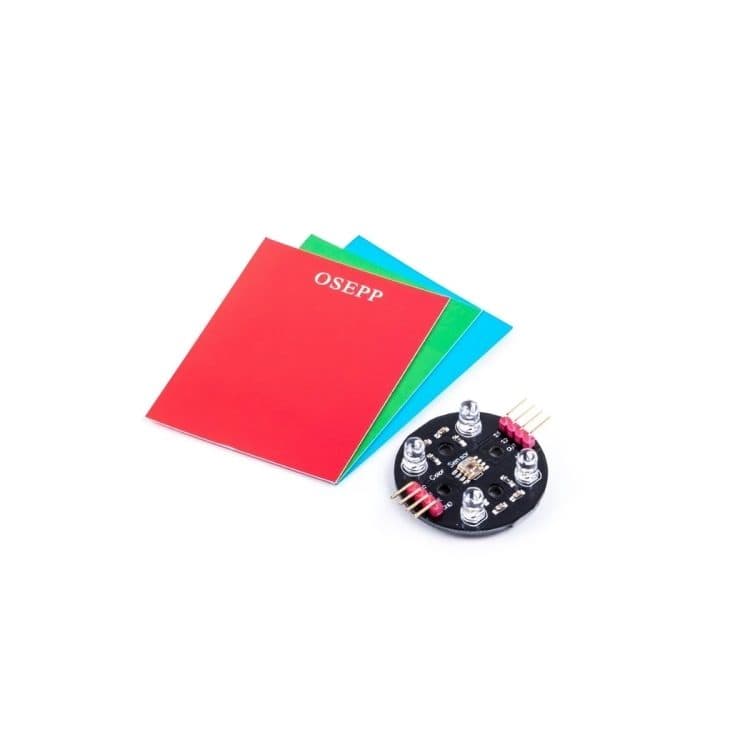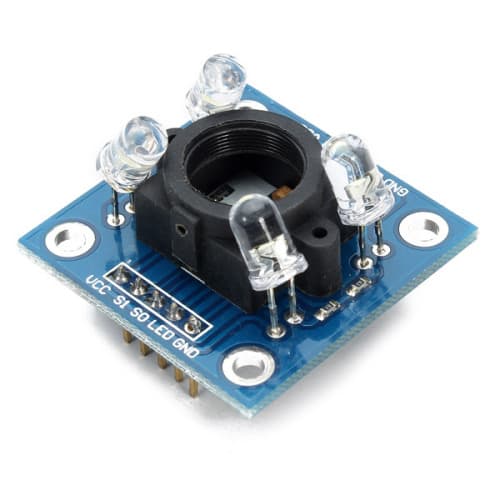
TCS3200 RGB Color Sensor Module with White LEDs (GY-31)
Prices updated: 12 Oct 2026
Compare prices
| Store | product | Price | View in store |
|---|---|---|---|
 Makers ElectronicsCheapest Makers ElectronicsCheapest | GY-31 TCS3200 Color Sensor Recognition Module | 260 EGP | View in store |
 RAM Electronics RAM Electronics | Color Sensor TCS3200 | 275 EGP | View in store |
 Microohm Microohm | GY-31 TCS3200 Color Sensor Module | 420 EGP475 | View in store |
Price history
Lowest daily price, last 90 days
Not enough price history yet.
Lowest price recorded: 260 EGP
About this product
The TCS3200 is a color sensor with an 8x8 photodiode array filtered for red, green, blue and clear light, plus four white LEDs for illumination. It outputs a square wave whose frequency is proportional to light intensity, which a microcontroller can measure to identify colors. Common uses include color sorting, test strip reading and color matching projects.
Specifications
- Sensor type
- RGB color sensor with clear filter
- Photodiode array
- 8 x 8 (64 photodiodes)
- Output
- Square wave, frequency proportional to light intensity
- Built-in illumination
- 4 white LEDs
- Supply voltage
- 2.7 V to 5.5 V
Frequently asked questions
What is the price of TCS3200 RGB Color Sensor Module with White LEDs (GY-31) in Egypt?
TCS3200 RGB Color Sensor Module with White LEDs (GY-31) currently costs between 260 and 420 EGP across 3 offers in Egypt.
Where can I buy TCS3200 RGB Color Sensor Module with White LEDs (GY-31) in Egypt?
TCS3200 RGB Color Sensor Module with White LEDs (GY-31) is available from Makers Electronics, RAM Electronics, and Microohm. Compare the offers above to find the best price.
How do I connect the TCS3200 to an Arduino?
Connect VCC to 5V, GND to GND and OUT to a digital input pin. Connect S0 and S1 to set the output frequency scaling, S2 and S3 to select the color filter, and OE to GND to enable the output. The four control pins can also be wired to digital pins so the code can switch them.
Do I need to calibrate the TCS3200 readings?
Yes. The output frequency depends on the lighting, the distance to the surface and the surface itself. Calibrate by measuring a known white reference and a black reference, then map your readings between those two values.